The Spec Almost Nobody Asks About: A Buyer's Guide to Compression Set
Short version: Before you buy an anti-fatigue mat, ask one question: "What's the compression set of this material, and how was it tested?" A good answer is a number, a named test method with its conditions, and a report from an accredited lab. This guide explains why that number matters, how to read it, and how to compare vendors fairly.
Two mats that feel the same on day one
When facilities compare anti-fatigue mats, the conversation usually lands on thickness, price and how the mat feels underfoot in the showroom. Those are reasonable things to check, but none of them tells you what the mat will feel like after months of someone standing in the same spot for every shift.
That is where mats quietly fail. The cushion doesn't wear away all at once. It flattens where people stand most: in front of the line station, at the register, at the sink. The edges of the mat still look thick, so nobody flags it, while the people standing on the flat spot lose the support the mat was bought to give them.
The property that predicts this is called compression set, and it is one of the few mat specs that is measured under a published standard. Most buyers never ask for it.
What compression set is
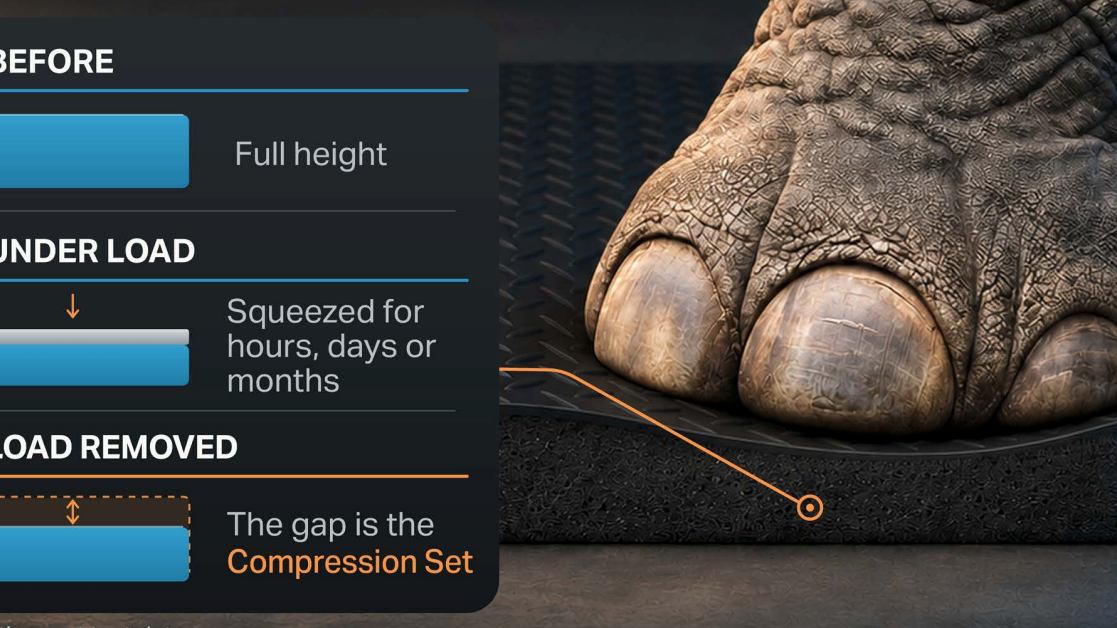
Compression set measures how much a material stays flattened after it has been squeezed for a long time. A sample is compressed to a fixed fraction of its thickness, held there, released, and given time to recover. Whatever thickness it fails to get back is its compression set.
For polyurethane foams, the usual method is ASTM D3574, Test D (constant deflection compression set). In the version used for the results below, the sample is compressed to 50% of its thickness for 22 continuous hours, released, and measured after a 30-minute recovery. The result is expressed as a percentage of the original thickness:
Compression set (%) = (original thickness − recovered thickness) ÷ original thickness × 100
So a 10% compression set means the sample stayed 10% thinner than it started. Lower is better.
Two terms you'll see used for the same result:
- Permanent set: the thickness that didn't come back (for example, 6.24%).
- Recovery: the thickness that did come back (for example, 93.8%).
Why it matters on the floor
Compression set is a direct measure of the failure mode people actually notice: a mat that springs back versus a mat that stays flat. A material with low compression set keeps returning to its original shape after hours under load. A material with high compression set takes on a permanent impression, and that impression forms exactly where a worker stands every day.
For anyone responsible for an anti-fatigue program, that has practical consequences:
- The support goes first, the appearance second. A mat can look serviceable while delivering much less cushion in the standing zone than it did when it was installed.
- Replacement cycles get shorter. A mat that flattens has to be repurchased, received, distributed and disposed of sooner.
- The program loses credibility. When people stop feeling a difference, they stop believing the mats help, and start improvising with cardboard and rags.
How to read a compression set number
A compression set result only means something alongside the conditions it was measured under. The same material can produce noticeably different numbers depending on how the test was run, so before comparing two figures, check that these match:
- The standard. ASTM D3574 covers flexible cellular polyurethane. Rubber and other materials are often tested under different standards, such as ASTM D395 or ASTM D1056.
- How far it was compressed. 50% deflection is common for D3574 Test D, but 75% and 90% versions exist. A deeper squeeze is a harsher test.
- How long and how hot. 22 hours is a standard duration. Many foam specifications run the test heated, commonly at 70°C (158°F), which is harsher than room temperature. The rubber standard ASTM D395 says outright that comparative tests should use identical temperature and time.
- How the result was calculated. D3574 expresses set as a percentage of original thickness. Some other methods express it as a percentage of the deflection, which produces a higher number for the same sample. Rogers Corporation, a foam manufacturer, notes that you need to know the calculation method before comparing values.
- Who tested it, and what was tested. Look for a third-party lab accredited by A2LA or to ISO/IEC 17025, and for results on the finished product rather than a raw-material sample.
If two vendors' numbers differ on any of these, you're not comparing like with like, and the honest answer is to ask both for results under the same conditions.
What a good result looks like
There is no single industry-wide pass mark for anti-fatigue mats, but material makers give useful reference points. Rogers Corporation describes compression set under 5% as typical of high-performance polyurethane and silicone foams, and its PORON industrial polyurethanes are specified at a maximum of 10% when tested at 70°C. Single-digit results from a recognized method are a strong sign. Anything well above that is a reason to ask more questions about how the mat will hold up.
The question to ask your vendor
Ask: "What's the compression set of this material, and how was it tested?"
A complete answer gives you:
- ☐ A number, stated as permanent set or recovery
- ☐ The method and conditions: standard and test (for example, ASTM D3574 Test D), deflection, duration and temperature
- ☐ An independent lab report from an A2LA or ISO/IEC 17025-accredited lab, on the finished mat
If a vendor can't tell you how their material holds up under sustained load, that tells you something too.
What compression set doesn't tell you
Compression set is a 22-hour laboratory test. It is a strong indicator of how a material behaves under sustained load, but it is not a lifespan prediction, and no single lab number converts directly into months of service.
Real standing isn't static either. People shift, step and walk across a mat thousands of times a shift. That is measured by a separate test, ASTM D3574 Test I (dynamic fatigue), which repeatedly strikes the material and measures the thickness lost. For a fuller picture, ask for both: compression set for the spot where someone stands still, dynamic fatigue for the traffic around it.
Our numbers
We hold our own mats to the same questions. WellnessMats Supreme and Connect were tested by Precision Testing Laboratories of Nashville, Tennessee, an A2LA-accredited lab (Certificate #7327.01), on the finished product.
| Test | Supreme | Connect |
|---|---|---|
| Compression set, ASTM D3574 Test D 22 h at 50% compression, 30-min recovery |
6.24% permanent set (93.8% recovered) |
8.06% permanent set (91.9% recovered) |
| Dynamic fatigue, ASTM D3574 Test I 80,000 impacts |
2.0% thickness loss | 1.9% thickness loss |
Source: Precision Testing Laboratories, Reports 61065 and 61066, February 26, 2026. Full results, including slip resistance and 11 other ASTM and AATCC tests, are on our Tests and Certifications page.
If you're evaluating mats now, ask every vendor on your list for the same three things above, including us.
Sources
- WellnessMats, Tests and Certifications: Precision Testing Laboratories Reports 61065 and 61066, Feb 26, 2026
- Rogers Corporation, Everything You Need to Know About Compression Set for Elastomeric Foam Materials (2024)
- Rogers Corporation, PORON 4701-60 product data
- Intertek, Compression Set Under Constant Deflection, ASTM D395 B
- ASTM International, D3574: Standard Test Methods for Flexible Cellular Materials (Slab, Bonded, and Molded Urethane Foams), Tests D and I
- ASTM International, D395: Standard Test Methods for Rubber Property (Compression Set)
Blog posts
The Spec Almost Nobody Asks About: A Buyer's Guide to Compression Set
Ergonomic Risk Assessment for Standing Work: An 8-Part Checklist for EHS Teams