Which Jobs Stand the Most? New Federal Data on Prolonged Standing at Work
Which jobs require the most standing?
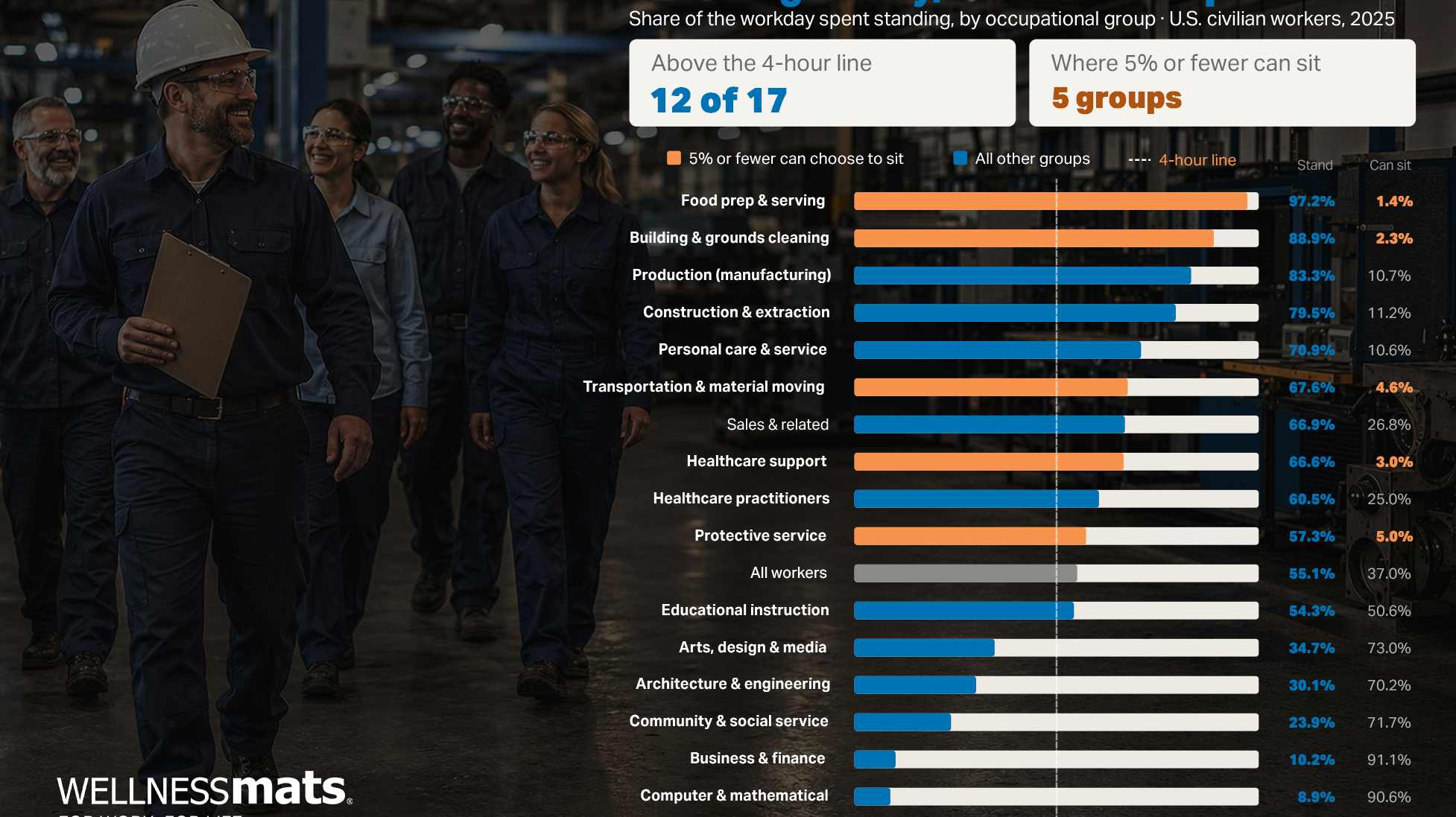
Food preparation and serving workers spend 97.2% of the workday standing, the most of any occupational group in the United States. Building and grounds cleaning workers stand 88.9% of the workday, production and manufacturing workers 83.3%, and construction workers 79.5%. Across all civilian workers, the average is 55.1%.
Those figures come from the U.S. Bureau of Labor Statistics Occupational Requirements Survey, released January 16, 2026 for the 2025 reference year. The survey is based on a probability sample of 27,100 establishments and represents roughly 148.7 million civilian workers. Unlike most workplace posture research, it does not rely on workers estimating their own habits. Field economists record what the job actually requires.
The survey also captures something that most coverage of standing at work misses entirely: whether a worker has the option to sit down instead.
Key findings at a glance
- Twelve of seventeen occupational groups spend more than half the workday standing.
- In five occupational groups, 5% or fewer of workers can choose between sitting and standing.
- Food service workers stand 97.2% of the workday. Only 1.4% have the option to sit.
- The gap between standing time and sit availability does not track cleanly. Some groups stand a great deal and still have latitude. Others do not.
How much of the workday does each occupation spend standing?
The table below shows the share of the workday spent standing for each major occupational group, alongside the share of workers in that group who can choose between sitting and standing.
| Occupational group | Standing (% of workday) | Can choose to sit |
|---|---|---|
| Food preparation and serving | 97.2% | 1.4% |
| Building and grounds cleaning | 88.9% | 2.3% |
| Production (manufacturing) | 83.3% | 10.7% |
| Construction and extraction | 79.5% | 11.2% |
| Personal care and service | 70.9% | 10.6% |
| Transportation and material moving | 67.6% | 4.6% |
| Sales and related | 66.9% | 26.8% |
| Healthcare support | 66.6% | 3.0% |
| Healthcare practitioners and technical | 60.5% | 25.0% |
| Protective service | 57.3% | 5.0% |
| All civilian workers | 55.1% | 37.0% |
| Educational instruction and library | 54.3% | 50.6% |
| Arts, design, entertainment and media | 34.7% | 73.0% |
| Architecture and engineering | 30.1% | 70.2% |
| Community and social service | 23.9% | 71.7% |
| Business and financial operations | 10.2% | 91.1% |
| Computer and mathematical | 8.9% | 90.6% |
Source: U.S. Bureau of Labor Statistics, Occupational Requirements Survey, 2025.
What counts as standing in the BLS data?
The Bureau of Labor Statistics defines standing as any work time not spent sitting or lying down. That includes walking, climbing, and low postures such as stooping, kneeling, crouching, and crawling. In practical terms, the measure is time on your feet rather than time standing still.
There is a second definition that matters far more, and it is the reason these numbers are stronger evidence than they first appear.
When a worker may choose between sitting and standing, the Bureau counts that time as sitting.
Read that again in the context of the table above. Discretionary standing has already been removed from every percentage. A retail associate who leans against a counter by choice is counted as sitting. A nurse who could take a stool but does not is counted as sitting. What remains in the standing column is standing the job requires.
So when the data says food service workers stand 97.2% of the workday, it is not describing a preference or a habit. It is describing a requirement.
What is prolonged standing, and where does the four hour threshold come from?
The National Institute for Occupational Safety and Health, part of the Centers for Disease Control and Prevention, defines prolonged standing as standing continuously for more than one hour, or standing for more than four hours in a day.
Four hours is a useful line to draw across the BLS data. On a standard eight hour shift, four hours is 50% of the workday. Twelve of the seventeen occupational groups above cross it. So does the all worker average, at 55.1%.
NIOSH notes that prolonged standing is associated with pain, discomfort, and fatigue, and it lists floor matting among the interventions employers use to reduce those effects, alongside footwear, job rotation, and adjustable workstations.
One caveat worth stating plainly: the hours conversion is ours, not the Bureau's. BLS publishes percentage of the workday, and scheduled workdays vary by occupation. Treat any hours figure as an approximation on an eight hour baseline.
Which workers cannot choose to sit down?
This is the finding that deserves more attention than total standing time, and it is where the data gets uncomfortable.
Five occupational groups have a sit or stand choice available to 5% or fewer of workers:
| Occupational group | Standing | Can choose to sit |
|---|---|---|
| Food preparation and serving | 97.2% | 1.4% |
| Building and grounds cleaning | 88.9% | 2.3% |
| Healthcare support | 66.6% | 3.0% |
| Transportation and material moving | 67.6% | 4.6% |
| Protective service | 57.3% | 5.0% |
Compare that to business and financial operations, where 91.1% of workers can choose, and computer and mathematical occupations, where 90.6% can. Both of those groups stand roughly one tenth of the workday to begin with.
The pattern that emerges is not simply that some jobs stand more. It is that the workers who stand the most tend to have the least say in it, while the workers with the most postural freedom need it least.
The averages hide the worst cases
Group level numbers can mislead, and two examples are worth flagging before anyone quotes them.
Sales and related occupations show 26.8% of workers able to choose to sit. That figure is inflated by outside sales representatives, real estate brokers, and sales engineers, most of whom work seated or in vehicles. Retail salespersons on their own stand 83.0% of the workday, and only 4.1% can choose to sit.
Healthcare practitioners show 25.0%. Nursing assistants on their own stand 79.2% of the workday, and 2.2% can choose to sit.
If you are building a case for a specific workforce, use the occupation, not the group.
Which specific job titles stand the most?
| Job title | Standing (% of workday) |
|---|---|
| Bakers | 98.9% |
| Waiters and waitresses | 98.6% |
| Bartenders | 98.3% |
| Dishwashers | 98.2% |
| Maids and housekeeping cleaners | 95.2% |
| Carpenters | 94.2% |
| Construction laborers | 89.2% |
| Chefs and head cooks | 88.8% |
| Electricians | 88.7% |
| Retail salespersons | 83.0% |
| Nursing assistants | 79.2% |
| Pharmacists | 72.3% |
| Licensed practical and vocational nurses | 66.2% |
| Secondary school teachers | 60.4% |
| Dental assistants | 50.4% |
| Accountants and auditors | 3.8% |
| Software developers | 2.9% |
For waiters, bartenders, and housekeeping cleaners, fewer than 0.5% of workers can choose to sit.
Why the sit or stand choice matters more than total standing time
Workplace ergonomics spending has concentrated for two decades on desk work. Sit stand desks, monitor arms, keyboard trays, and chair upgrades all went to the population that, according to this data, already had the most control over its own posture.
The BLS numbers suggest a different allocation question. If postural freedom is the variable that matters, then the workers with the greatest need are in kitchens, on housekeeping carts, in warehouses, on assembly lines, and in patient care. These are also the roles where the intervention cannot be a chair, because the work does not permit sitting. A line cook cannot sit. A nursing assistant transferring a patient cannot sit. A picker walking a warehouse aisle cannot sit.
When sitting is not available, the remaining levers are the surface underfoot, footwear, scheduled recovery breaks, and job rotation. That is a narrower toolkit than desk ergonomics offers, which is precisely why it deserves deliberate attention rather than default neglect.
What can employers do about prolonged standing?
There is no single fix, and any vendor who tells you otherwise is selling rather than advising. NIOSH and the broader occupational health literature point to a combination of approaches:
- Reduce the standing surface hardness. Anti-fatigue matting at fixed workstations addresses the concrete floors common in kitchens, production lines, retail counters, and salons.
- Introduce postural variety. Where the task allows, sit stand stools, leaning supports, or footrests let workers shift load without leaving the station.
- Rotate tasks. Alternating between standing intensive and mixed posture tasks across a shift spreads the load.
- Schedule real recovery breaks. Brief, regular breaks are more effective than a single long one.
- Address footwear. Supportive footwear policies and allowances are low cost relative to their effect.
- Measure before you buy. Walk the floor, identify the fixed stations where workers spend the most continuous time, and prioritize those.
The last point matters most. The BLS data tells you which occupations are exposed. It does not tell you which stations in your building are the problem. That requires observation.
Frequently asked questions
How many hours a day do most workers stand? Across all U.S. civilian workers, standing accounts for 55.1% of the workday, or roughly 4.4 hours on an eight hour shift, according to the 2025 BLS Occupational Requirements Survey.
Which occupation stands the most? Food preparation and serving related occupations stand the most, at 97.2% of the workday. Among individual job titles, bakers lead at 98.9%, followed by waiters and waitresses at 98.6%.
How long do nurses stand each day? Healthcare practitioners and technical occupations stand 60.5% of the workday. Licensed practical and vocational nurses stand 66.2%, and nursing assistants stand 79.2%.
How long do retail workers stand? Retail salespersons stand 83.0% of the workday. Only 4.1% of them can choose between sitting and standing.
What is considered prolonged standing at work? NIOSH defines prolonged standing as standing continuously for more than one hour, or standing for more than four hours in a day.
Is standing all day worse than sitting all day? Both prolonged standing and prolonged sitting carry documented risks, and occupational health guidance generally favors postural variety over either extreme. The practical difference is that sedentary workers can usually introduce standing, while workers in standing intensive roles often cannot introduce sitting. In five occupational groups, 5% or fewer of workers have that option.
Do anti-fatigue mats help with prolonged standing? NIOSH lists floor matting among the interventions employers use to reduce the pain, discomfort, and fatigue associated with prolonged standing, alongside footwear, job rotation, and adjustable workstations. Matting addresses surface hardness specifically and works best as part of a combined approach.
Methodology and sources
All standing and sit or stand choice figures come from the U.S. Bureau of Labor Statistics Occupational Requirements Survey, 2025 reference year, published as Occupational Requirements in the United States, 2025 (USDL-26-0047, released January 16, 2026). The survey sampled 27,100 establishments and roughly 50,600 occupational observations, representing approximately 148.7 million civilian workers.
Three limitations to note:
- The ORS classifies work by occupation using the 2018 Standard Occupational Classification system, not by industry. These are occupational groups, not industries.
- BLS advises against comparing these estimates to previously published ORS years. The survey is not designed as a time series, so no trend claims should be drawn from it.
- The 2025 estimates are preliminary until the full third wave sample is aggregated.
The four hour prolonged standing threshold and the reference to floor matting come from the NIOSH Science Blog, Prolonged Standing at Work, published by the U.S. Centers for Disease Control and Prevention.
Sources
- U.S. Bureau of Labor Statistics, Occupational Requirements Survey: https://www.bls.gov/news.release/ors.htm
- BLS ORS occupational profiles: https://www.bls.gov/ors/factsheet/orsprofiles.htm
- NIOSH, Prolonged Standing at Work: https://www.cdc.gov/niosh/bulletin/2014/standing.html
Blog posts

The Goldilocks Problem: Why "Softer" Is the Wrong Spec for Commercial Anti-Fatigue Matting
Which Jobs Stand the Most? New Federal Data on Prolonged Standing at Work