From the Front Desk to the Guest-Room Floor: Wellness Is Now a Whole-Property Standard
For twenty years, the hotel fitness conversation lived in one room, usually a windowless one, in the basement, with a treadmill and a rack of dumbbells. That era is over, and the shift has been faster and more decisive than most operators expected.
Today the smartest properties treat wellness not as a single amenity but as a thread that runs through the entire stay: the check-in experience, the design of the room, the surface a guest stands on at the vanity, the equipment in the gym, and , increasingly, the floor space between the bed and the window. The industry has stopped asking whether a hotel has a gym and started asking what kind of physical experience the whole property delivers. Within five years, wellness won't be a differentiator at all. It will simply be the baseline expectation.
Here's what that shift looks like on the ground, and why the guest-room floor has quietly become the most contested square footage in the building.
The demand is no longer soft
The numbers that used to be used to justify wellness investment now read like table stakes. A Hilton survey found that 90% of travelers try to maintain their wellness routines while traveling. Roughly three-quarters of global travelers now prioritize wellness amenities when choosing where to book. And for the generation moving into peak travel-spending years, the stakes are higher still, high-end fitness amenities have become a deciding factor for a majority of Gen Z travelers selecting a hotel.
The more revealing number is the gap between intent and satisfaction. Surveys have found that while most guests intend to exercise during a stay, only a minority come away satisfied with the hotel's fitness offering. That gap is the opportunity. It is also the reason a fitness room now sits inside the brand standards that franchise auditors check, and the reason a property without a credible wellness offering can vanish from a guest's search results before the photos even load.
The financial case has kept pace. Properties that genuinely integrate fitness and wellness, not as a spa afterthought, but as a coherent experience, are seeing meaningful lifts in revenue per available room and stronger direct-booking rates from exactly the high-value travelers every brand wants. Wellness, as one IHG executive put it, increases the stickiness of the relationship between a brand and its guests.
Wellness moved into the room
The most important structural change is where fitness now happens. It has moved out of the shared gym and into the guest room.
Hilton saw this early. It launched Five Feet to Fitness in 2017, an in-room workout concept built around a functional-training rig, and has since expanded it alongside a headline partnership with Peloton, putting bikes, mats, resistance bands, and on-demand content directly into guest rooms at select properties, with streamable classes now available across thousands of hotels. IHG's EVEN Hotels built an entire brand on in-room "training zones." Marriott's Westin offers in-room workout gear, and Wyndham's Tryp puts fitness rooms on the booking menu.
The willingness-to-pay data explains why brands are moving. In a recent industry survey, a large share of connected-fitness members reported that they work out in their hotel room when traveling, and that both members and non-members were willing to pay more than $40 extra per night for in-room fitness equipment. Hotels have found that guests will select a property specifically because of what's waiting for them in the room.
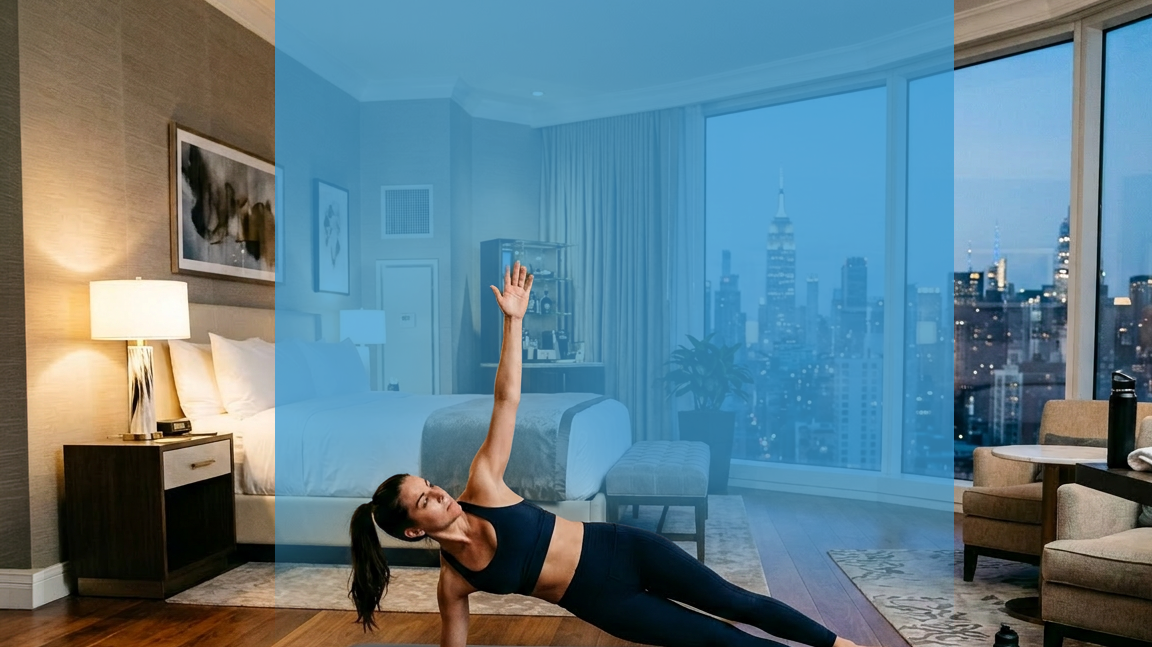
This matters for a simple reason: the guest-room floor is now a workout surface. And most of the industry is treating it as an afterthought.
The strength-and-recovery shift favors the floor
The other quiet revolution is what guests do when they exercise. The 2026 equipment conversation has tilted away from banks of cardio machines toward strength, functional movement, and recovery. Because hotel fitness spaces are unstaffed and sit close to sleeping guests, the winning formula is quiet, intuitive, floor-based movement that's safe to do alone, stretching, mobility, bodyweight strength, yoga, recovery.
Look at the no-equipment content the major brands are pushing into rooms: cardio, strength, yoga, barre, stretching, Pilates. Nearly all of it happens on the floor. Which raises an obvious question every operator should be asking: what is the guest actually standing, kneeling, and lying on?
The surface is the amenity nobody named
Here is the telling detail. When Hilton engineered its in-room fitness experience, it didn't just wheel in equipment, it specified a purpose-built commercial flooring system in the workout zone, chosen specifically to reduce injury risk and to mitigate noise transfer to adjacent rooms. The surface was treated as a deliberate, named, engineered choice.
The mat, by contrast, was not. Across every public description of these programs, the yoga mat is listed generically, an unbranded commodity dropped in beside named partners like Peloton and TRX. No brand owns the in-room floor-surface category the way Peloton owns the bike.
That's a strategic blind spot, because the floor is where fatigue, stability, noise, and safety all converge. Anti-fatigue and performance matting speaks directly to the operator's real concerns: acoustic transfer to rooms below, guest stability during unsupervised movement, impact absorption, and liability in a 24/7 space with no staff on the floor. The surface isn't a throw-in accessory. It's infrastructure, and it belongs in the same considered conversation as the bike and the suspension trainer.
What "whole-property" actually means
The properties winning the wellness decade aren't the ones chasing the flashiest single amenity. The experts are blunt about it: today's traveler can instantly tell the difference between engineered performance and aesthetic wellness. A few candles and a meditation app don't create outcomes. What creates outcomes, and loyalty, and rate premium, is coherence: a wellness experience that shows up consistently from the front desk to the gym to the vanity to the guest-room floor.
That's the real reframe for operators. Stop thinking about wellness as a room you visit and start thinking about it as a standard the whole building meets. The guest notices the mat at the vanity, the stability underfoot in the gym, and the surface they roll out beside the bed, and they notice when those choices were made with the same care as everything else.
The hotels that treat every surface as part of the wellness promise will own the next five years. The ones still treating the floor as an afterthought will keep losing the guest who checks the fitness offering before they book, which is now most of them.
Blog posts

The Goldilocks Problem: Why "Softer" Is the Wrong Spec for Commercial Anti-Fatigue Matting
Which Jobs Stand the Most? New Federal Data on Prolonged Standing at Work