The Science Behind Standing: How Anti-Fatigue Mats Cut Muscle Fatigue by 32%
A hard floor is not a neutral surface. It is an active, unmanaged occupational health risk, and the peer-reviewed evidence, plus the ROI math, makes the case for treating it that way.
A hard floor is not a neutral surface. It is an active, unmanaged occupational health risk. NIOSH’s comprehensive literature review confirmed that prolonged standing consistently leads to low back pain, muscle pain, leg swelling, and physical fatigue, and the agency identifies floor mats among its recommended interventions.
What Happens to the Body During Prolonged Standing
Standing is metabolically more demanding than sitting, and over an 8-hour shift that added load compounds into measurable physiological stress across the lower body. The core mechanism is reduced circulation in the lower limbs: when a worker stands still on a rigid surface, calf-muscle contractions become less effective at pumping blood back toward the heart, blood pools in the legs, and localized fatigue builds in the lower back, legs, and feet as the shift wears on.
Mechanism vs. proof: An honest distinction. The blood-pooling explanation above is a widely cited physiological mechanism. Worth noting: the NIOSH review found the objective physiological measures (including leg-volume and circulation data) to be mixed and inconclusive, while the self-reported reductions in discomfort and fatigue were consistent across studies. The strongest, most defensible claim for matting is the comfort-and-fatigue one — and that’s the one we lead with.
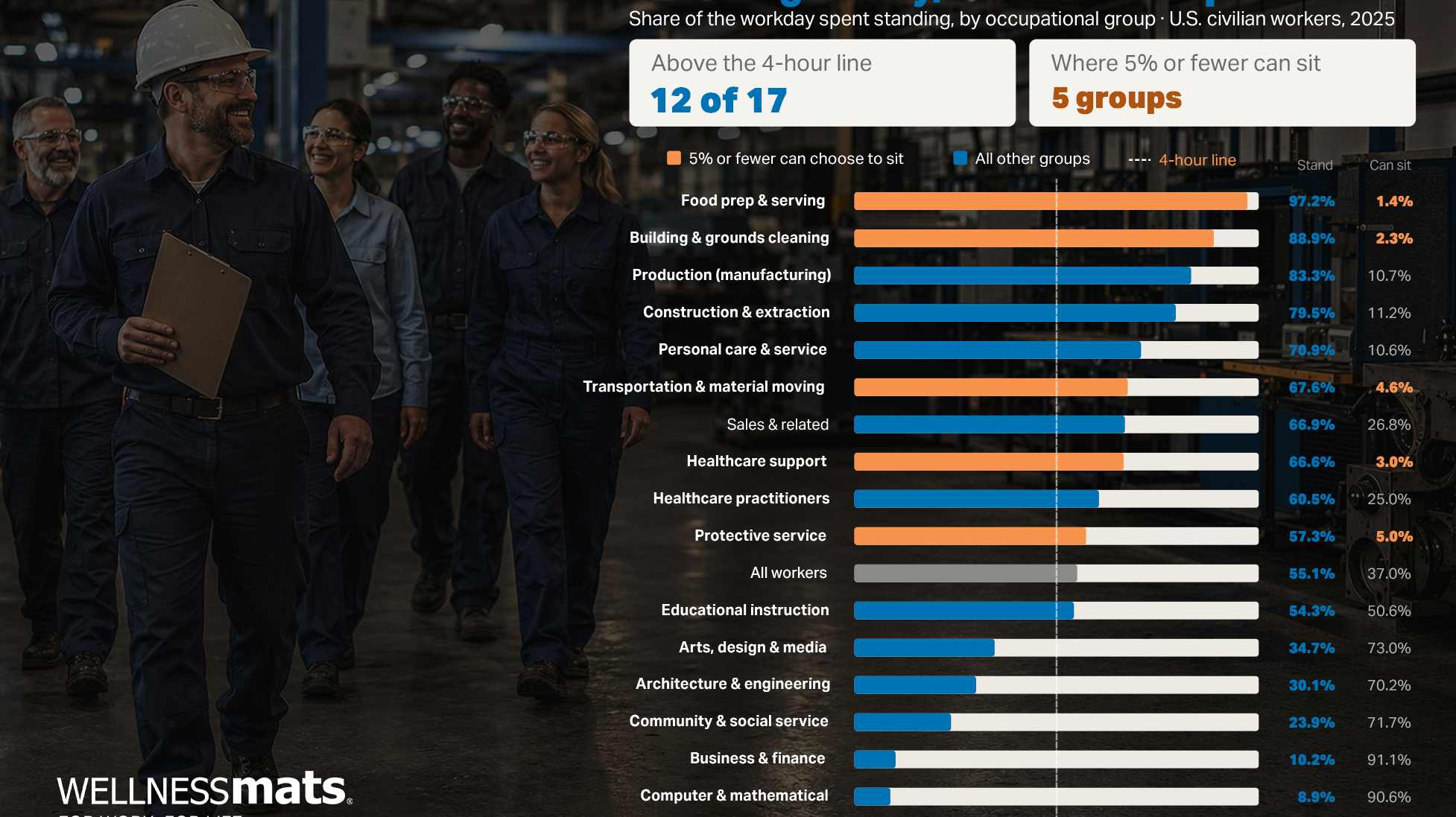
Research using the Prolonged Standing Strain Index (PSSI) found that standing continuously for more than one hour can push a job into the unsafe range. That threshold is routinely exceeded in manufacturing, healthcare, retail, and hospitality, sometimes for entire shifts without meaningful seated recovery.
BLS data confirms the downstream consequences: MSDs make up a large share of all cases involving days away from work, with a median of about two weeks off per case. For a facility manager, every worker standing on a hard floor for a full shift is accumulating physiological stress that translates directly into claim risk, absenteeism, and output degradation.
The body keeps a running tab. The question is whether you address it proactively or pay for it reactively.
What the Research Actually Shows About Mats
The peer-reviewed evidence points consistently in one direction: a compliant standing surface reduces the discomfort and fatigue that build during prolonged standing, compared with a hard floor. A controlled study of workers standing for four hours found that, compared with standing directly on hard ground, an anti-fatigue mat reduced the negative effects of prolonged standing on gait and fatigue.
The mechanism is well understood. A slightly unstable, compliant surface prompts continuous micro-movements in the feet and lower legs. Those micro-movements keep the lower-leg muscles gently active, which supports circulation and counteracts the stillness that drives standing fatigue.
The most recent rigorous evidence comes from a 2025 randomized controlled trial in Laryngoscope Investigative Otolaryngology, which found that anti-fatigue mats were an effective, low-cost intervention for reducing the musculoskeletal symptoms experienced by surgical teams during long procedures. That’s current, clinically rigorous evidence from one of the most demanding standing environments imaginable, and it converges with the NIOSH review’s conclusion that floor mats are among the interventions effective at reducing the hazards of prolonged standing.
The benefit is most pronounced where it matters most: for workers already prone to lower-back discomfort, and after several hours of continuous standing, exactly the long-shift population that drives MSD claims.
Why Mat Material and Density Are Critical: Not All Mats Are Equal
Here is the part that separates engineering from marketing: fatigue reduction depends on getting the compression density right. A mat that’s too soft can actually increase muscle fatigue by forcing stabilizer muscles to overwork, think jogging on soft sand versus a firm track. The optimal mat gives enough to reduce joint impact and trigger those micro-movements, while staying firm enough to keep muscles productively engaged rather than overloaded.
This is exactly why WellnessMats engineered its proprietary Advanced Polyurethane Technology (APT™). The one-piece, solid polyurethane construction is built to a supportive density that holds its performance, it doesn’t delaminate, curl, or compress into dead spots over years of daily use.
Independently tested: WellnessMats’ performance has been independently evaluated by Precision Testing Laboratories (A2LA-accredited, Certificate #7327.01)
WellnessMats Professional mats carry ASTM and NFSI certifications with ADA-compliant beveled edges, markers of verified, standardized performance, and are backed by a 10-year commercial warranty (20-year residential), a reflection of material integrity and long-term ROI rather than a marketing gesture.
The B2B ROI Case: The True Cost of Inaction
The procurement question isn’t “can we afford premium anti-fatigue mats?” It’s “can we afford the cost of not having them?” OSHA’s $afety Pays estimator puts hard numbers on a single strain:
• Direct costs (medical, workers’ comp): ~$32,000
• Indirect costs (productivity loss, reallocation): ~$35,000
• Total per incident: ~$67,000
Multiply that across a facility with dozens or hundreds of standing workers and the exposure becomes substantial. Ergonomic interventions are among the most reliable ways to reduce it: OSHA and Washington State L&I place the return on ergonomic and safety investments at roughly $3 to $6 for every $1 spent, driven by fewer injury claims, lower absenteeism, and improved productivity. Anti-fatigue mats are about the simplest such intervention available: no training, no behavioral change, no ongoing management overhead.
Washington State L&I’s review of more than 250 ergonomics case studies documents what that ROI looks like in practice. 3M reported a 64% reduction in its OSHA injury and illness rate after ergonomic improvements; Siemens VDO Automotive cut strain injuries from 43% to essentially zero and recovered roughly 20,000 hours a year previously lost to pain, doctor visits, and time off; Sikorsky accrued multimillion-dollar labor savings and tens of thousands in injury-cost avoidance per aircraft. (These are broad ergonomics programs rather than mat-only initiatives, but they show the scale of return a serious standing-comfort strategy participates in.)
Zoom out and the burden is a top-tier line item: musculoskeletal conditions cost the U.S. healthcare system hundreds of billions of dollars annually and rank among the leading employer cost drivers nationwide. WellnessMats are trusted by Fortune 500 companies including Amazon, FedEx, Delta, Costco, and Planet Fitness — enterprise validation that the ROI case has been stress-tested at scale.
Industry-Specific Risk: Where Standing Fatigue Hits Hardest
• Healthcare — OR surgical teams, nurses, and lab technicians stand for hours on unforgiving floors. The 2025 surgical RCT directly validated mat use in surgical settings, and MSD rates in healthcare remain among the highest of any sector.
• Manufacturing & Industrial — workers routinely exceed the one-hour safe standing threshold across full shifts. This is exactly where consistent, durable matting pays back fastest.
• Salon & Barbershop — stylists stand on hard tile for 6 to 10 hours daily, among the highest-risk populations for lower-back and leg fatigue. WellnessMats Smart Step Salon Mats carry a dedicated 5-year salon warranty.
• Retail — cashiers and floor associates stand on concrete for entire shifts; reducing fatigue at the checkout supports more consistent output and service quality.
• Hospitality — kitchen staff, front-desk personnel, and housekeeping teams face prolonged standing with little chance for seated recovery.
Each vertical has a distinct risk profile, but the underlying physiology and the mat solution are the same. The investment scales across every standing role in your facility.
The Science Is Clear, Now the Decision Is Yours
The evidence converges: anti-fatigue mats reduce the discomfort and fatigue of prolonged standing, but only when the material is engineered to the right density. Cheap foam doesn’t deliver the outcome. A premium mat is measured in hundreds of dollars; a single MSD claim, in tens of thousands.
WellnessMats offers custom sizing, modular Connect layouts for full-floor coverage, and branded logo options, all backed by a 10-year commercial warranty. Rated #1 by America’s Test Kitchen and holding a 4.8-star rating across 6,000+ reviews, WellnessMats has the validation to match the science.
Run the numbers on your own floor. Request a Quote or request a sample and feel the difference in your actual environment.
References
1. Waters, T.R. & Dick, R.B. (2015). Evidence of Health Risks Associated with Prolonged Standing at Work and Intervention Effectiveness. Rehabilitation Nursing, 40(3), 148–165. NIOSH. PMC4591921
2. U.S. Bureau of Labor Statistics — Survey of Occupational Injuries and Illnesses. bls.gov/news.release/osh.nr0.htm
3. Halim, I. & Omar, A.R. (2012). Prolonged Standing Strain Index. Int. J. of Occupational Safety and Ergonomics, 18(1), 85–96. PMID 22429532
4. Elliott, J., et al. (2025). Impact of Anti-Fatigue Floor Mat on Surgical Staff Comfort Levels. Laryngoscope Investigative Otolaryngology, 10(1), e70083. PMID 39882505
5. OSHA — “$afety Pays” Individual Injury Estimator (injury cost estimates; ergonomics ROI context). osha.gov/safetypays
6. Lin, C.-L., et al. (2021). Gait Characteristics and Fatigue Profiles When Standing on Surfaces with Different Hardness (4-hour standing study). PMC8615158
7. Ergonomics program case studies (3M, Siemens VDO, Sikorsky), as documented in the Washington State Department of Labor & Industries review of 250+ ergonomics case studies. [Confirm L&I source link before publishing.]
Blog posts

The Goldilocks Problem: Why "Softer" Is the Wrong Spec for Commercial Anti-Fatigue Matting
Which Jobs Stand the Most? New Federal Data on Prolonged Standing at Work