Why "Made in USA" Is More Than a Label
American manufacturing shapes a product's performance long before, and long after, it reaches the floor.
When a new anti-fatigue mat arrives at a facility, attention naturally goes to the product itself: how it feels underfoot, how it holds up to traffic, how it fits the space. That's the easy part to evaluate. But the mat in front of you is the final step in a much longer story, and increasingly, where that story takes place is one of the most important variables in whether a product actually delivers on its promise.
Every WellnessMat is manufactured in Sullivan, Missouri. That isn't a marketing line for us; it's an operating decision that shapes far more than a spec sheet. Here's what a mat's journey reveals about why domestic manufacturing has quietly become a business advantage.
The journey starts long before the floor
Before a mat is ever unboxed, materials are sourced, production runs, and the finished product moves through distribution. Each of those steps is a handoff, and every handoff introduces variables. The farther apart those steps are, geographically, operationally, contractually, the more room there is for small issues to compound into real ones.
Recent years have been a sharp reminder that where a product is made can affect far more than its price. It influences reliability, availability, and the strength of the long-term partnerships behind it. When you only look at the product on the floor, you're seeing the outcome without seeing the process that determined its quality.
Reliability begins with the materials
A mat's journey truly begins with what it's made of. The quality of those materials, and the consistency of the process that turns them into a finished product, plays an outsized role in how that product performs over the years it's expected to last.
Manufacturing closer to home tends to make that consistency easier to protect. It allows for greater oversight, faster adjustments when something needs to change, and clearer visibility into what's actually happening on the production line. When an issue does surface, a shorter chain means it can be identified and addressed more quickly. For products designed to support people for years, that quality has to be built in from the very first step, not inspected in at the end.
Proximity is a strategic advantage, not just a story
Here's the part that often gets overlooked: a mat's journey doesn't end when it leaves the production floor. Organizations grow. Projects evolve. Priorities shift. What you need six months from now may not be what you ordered today.
Shorter supply chains provide flexibility in exactly those moments, better communication, faster response, and fewer unknowns when circumstances change. It's why the National Association of Manufacturers continues to cite supply chain resilience as a top priority across industries, and why more and more organizations are treating responsiveness and reliability as being just as valuable as the product itself. In a lot of categories, that responsiveness has quietly become the competitive edge.
The value beyond the product
By the time a mat reaches a facility floor, every step in its journey has already shaped its quality and reliability. Where it's made affects more than logistics, it affects visibility into production, consistency in output, and the ability to respond when needs shift.
In today's environment, reducing uncertainty can be just as valuable as reducing expense. A shorter, more connected journey simply means fewer surprises along the way. Sometimes the distance between a challenge and a solution is nothing more than being closer to the source.
Built here. Designed to last.
Every WellnessMat is 100% Made in America, manufactured at our Sullivan, Missouri facility. By keeping production close to home, we maintain tighter control over quality, offer more responsive support, and help our customers navigate changing needs with confidence, all while supporting the communities and people who support us.
As America approaches its 250th anniversary, it's a fitting moment to remember that where products are made still matters. Not only for national pride, but for something more practical: reliability, responsiveness, and resilience.
That's the home field advantage, and it's built into every mat, long before it reaches your floor.
Curious how domestic manufacturing translates into a more reliable floor for your team? Learn more about our commercial solutions, or take our free Ergonomic Risk Assessment to see where anti-fatigue matting fits into your workplace.
Blog posts

The Goldilocks Problem: Why "Softer" Is the Wrong Spec for Commercial Anti-Fatigue Matting
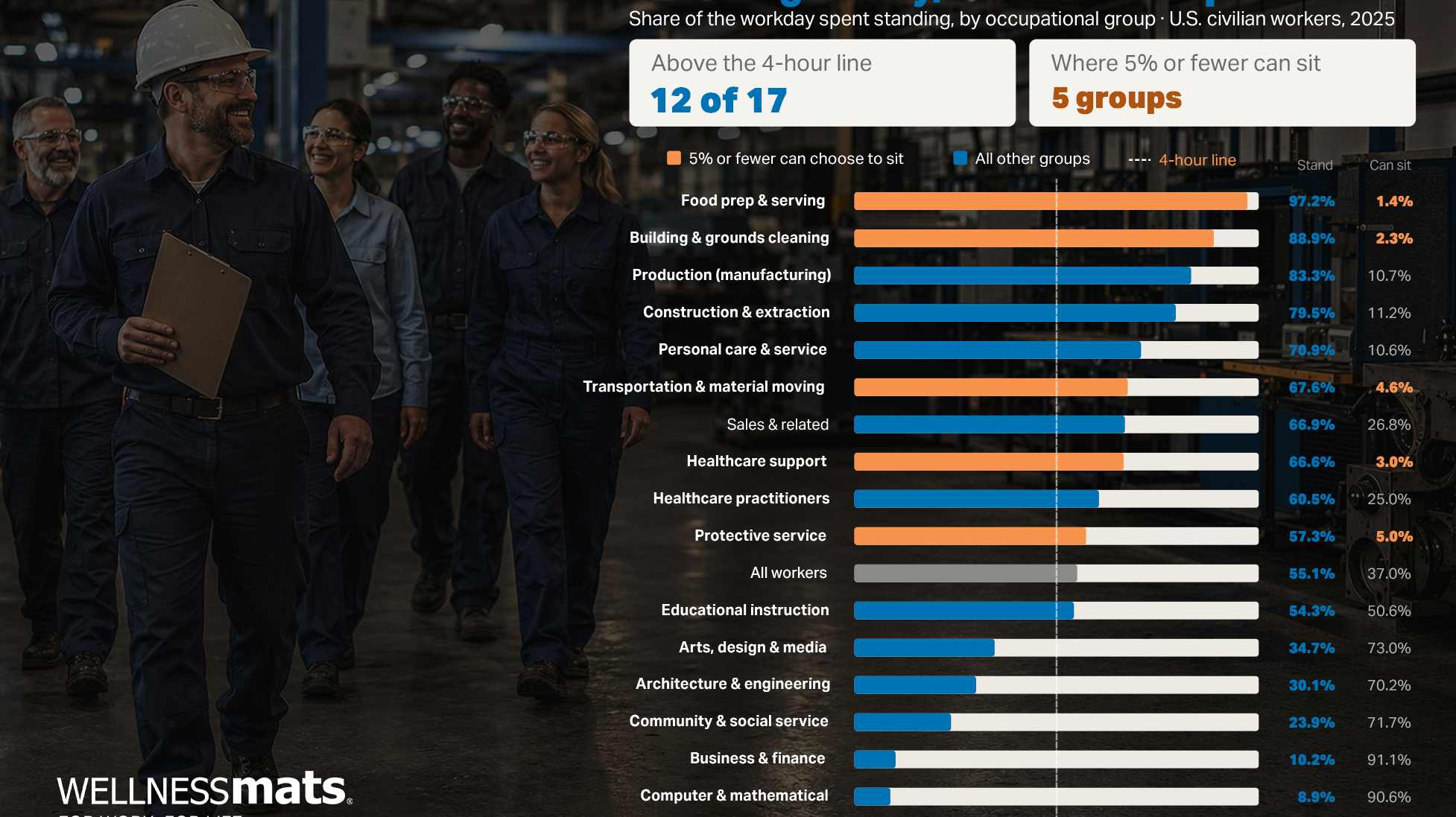
Which Jobs Stand the Most? New Federal Data on Prolonged Standing at Work