Search interest in “employee wellness” has nearly quadrupled. The data underneath that curve is the real story — and why the next generation of wellness programs will be built on floors, not apps.
A signal you can’t ignore
Something happened to “employee wellness” over the last twelve months. After four years of flat, modest search interest — the kind of steady baseline that suggests a topic people care about but rarely act on — Google Trends data shows the phrase suddenly breaking out, nearly quadrupling from its long-term average and hitting an all-time high this fall.
That kind of curve doesn’t appear because people are curious. It appears because budgets are moving, RFPs are being written, and decisions are being made.
A five-year baseline that suddenly breaks out isn’t a trend. It’s a market repricing what matters.
For anyone building, selling, or advocating for workplace health — whether you’re an EHS director, a facilities manager, a benefits leader, or a procurement buyer — the question is no longer whether employee wellness belongs on the roadmap. It’s where to spend first, and how to prove the return.
Why the curve broke now
Three forces converged:
- The cost of doing nothing got impossible to ignore. The 2025 Liberty Mutual Workplace Safety Index pegs the annual cost of serious workplace injuries in the U.S. at $58.8 billion — with overexertion from outside sources alone accounting for $13.7 billion. That’s the #1 cause of serious injury, and it has been for twenty-five consecutive years.
- The workforce changed what it expects. Deloitte’s analysis found that every £1 invested in workplace mental health returns an average of £4.70 — and proactive, culture-level interventions return closer to £5.60. The business case stopped being soft.
- The “wellness perk” era ended. Gym stipends and meditation apps haven’t moved the needle on the injuries and productivity losses that actually hit the P&L. CFOs started asking harder questions. Wellness budgets began migrating toward interventions that show up in claims data, not just engagement surveys.
The search curve is the downstream signal of those three forces finally meeting.
What “wellness” actually costs when you don’t fund it
Every workplace wellness conversation eventually lands in the same place: someone asks what it’s worth. Here’s what the data says.
Workers’ compensation benefit costs have risen roughly 30% over the last 25 years, even as injury rates fell 40%. Fewer injuries, but dramatically more expensive ones. The delta is medical inflation, longer recovery timelines, and the compounding cost of musculoskeletal claims.
The expensive part of wellness isn’t the program. It’s the injury you didn’t prevent.
The ergonomic blind spot
Here’s what most wellness strategies miss: the largest, most predictable, most expensive category of workplace injury is also the one least addressed by conventional wellness programs.
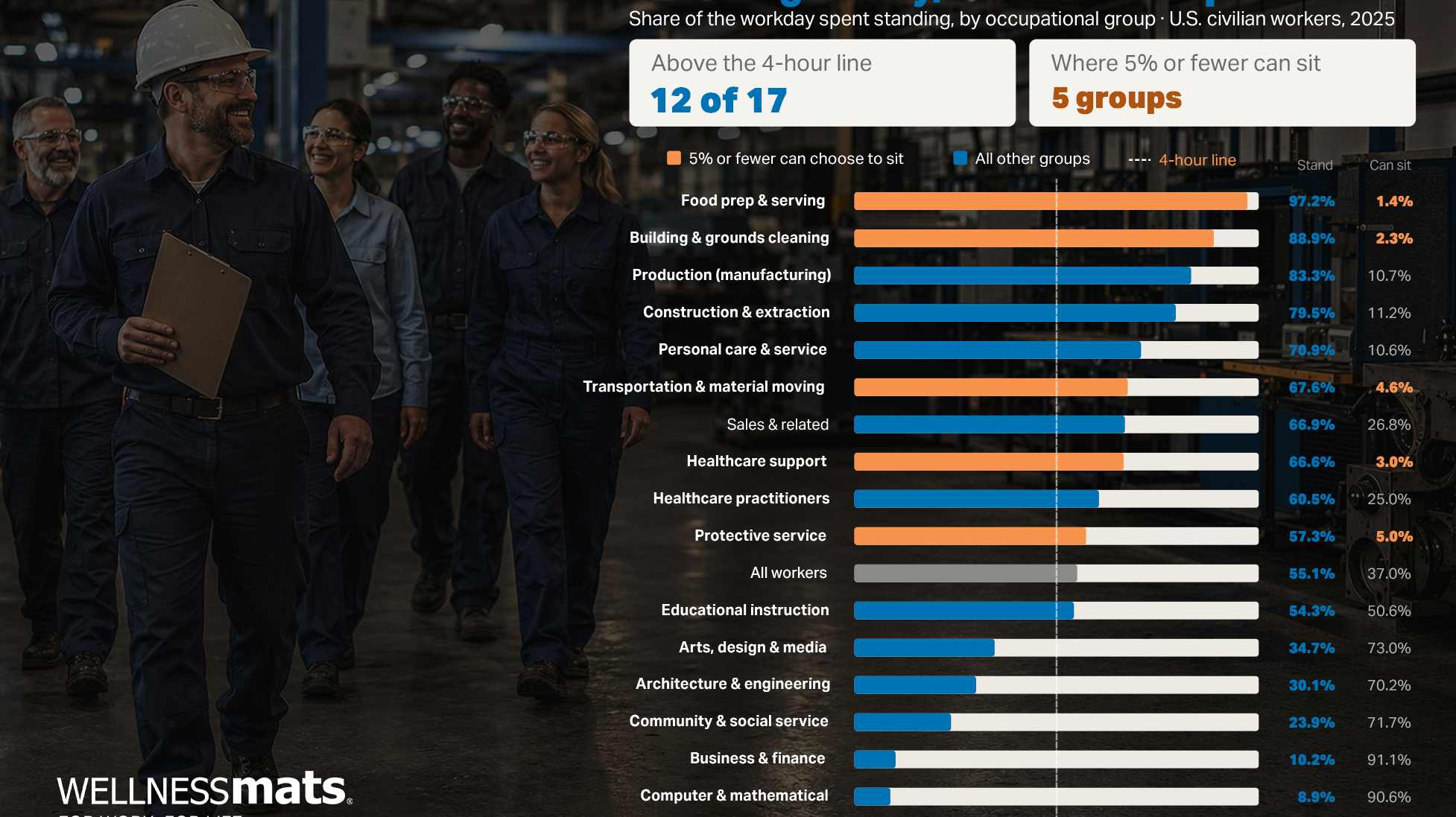
An EAP doesn’t fix a concrete floor. A step-challenge app doesn’t reduce lumbar load on a packing line. A mindfulness subscription doesn’t help the stylist on her feet for nine hours, the nurse on a twelve-hour shift, or the assembler whose workstation was built for throughput, not for a human body.
Standing surface, posture support, and the physical conditions of the work itself account for a huge share of the injuries that actually move the P&L — and they’re the interventions with the shortest path to measurable results. You don’t need a three-year rollout to feel the difference in fatigue scores and complaint rates. You need a week.
Every wellness program has a ceiling, and the ceiling is the floor people stand on.
What the next generation of wellness programs will do differently
The organizations we’re seeing pull ahead in 2026 share three patterns:
- They start with measurement, not procurement. Before they buy anything, they assess. Not a compliance audit — an honest baseline of where fatigue, discomfort, and risk actually live in the workday. Which workstations, which shifts, which tasks, which body parts. That baseline becomes the business case for everything that follows and the benchmark for proving ROI.
- They treat ergonomics as infrastructure, not accommodation. The old model waited for a complaint, then retrofitted a workstation. The new model treats the physical environment as part of the operating system of the workplace — engineered, standardized, measured. Anti-fatigue surfaces, height-correct stations, posture-supportive equipment aren’t perks issued to individuals. They’re floor-level infrastructure deployed across the environment.
- They connect physical wellbeing to the financial story. Injury reduction. Workers’ comp trend. Turnover in physically demanding roles. Productivity per shift. Absenteeism and presenteeism. These are the metrics leaders can take to a CFO, and they’re the metrics a physical-wellbeing program can actually move — in quarters, not years.
Where to start
You can’t improve what you haven’t measured. But the gap between “we should look at ergonomics” and “we have a plan” is where most wellness initiatives die — usually because the next step looks like a six-figure consulting engagement and a three-month calendar.
That gap is the reason we built the WellnessMats Ergonomic Employee Survey.
It’s a short, free assessment designed for the person who already suspects their workforce is paying a hidden cost in fatigue, discomfort, and complaint volume — and wants a starting point that takes minutes, not months. It surfaces:
- Where fatigue and discomfort are concentrated across your workforce — by role, shift, and workstation type.
- The specific physical stressors most likely driving risk on your floor — standing surface, workstation height, task duration, recovery time.
- A prioritized, practical path forward — what to pilot, where, and how to measure whether it’s working.
It’s not designed to sell you anything. It’s designed to give you a defensible, data-backed answer to the next question your leadership is going to ask: “where should we actually invest first?”
Add your branding to our pre-made employee comfort survey.
Get a unique link to send the survey to your team, receive anonymous results directly back to your email. Find out how your team is really feeling about how they're standing.
Get Your Survey →The bottom line
The Google Trends curve isn’t a fashion cycle. It’s a market finally catching up to what the injury data has said for twenty-five years: the cost of an undersupported workforce is real, measurable, and growing. And the highest-ROI interventions aren’t the ones with the shiniest apps — they’re the ones that change what happens to a human body over the course of a shift.
The employers who act on this early won’t just reduce injury costs. They’ll be measurably better places to work — and in a labor market where retention and recruitment are business-critical, that’s the compounding return the search curve is really pricing in.
Start with the assessment. Start with the floor. The rest gets a lot easier from there.